

Google has documentation, published ranking factors, and webmaster forums where you can ask a real person. Telegram has none of that. The company has never published the algorithm behind its channel search, and Pavel Durov comments on the topic once every year or two, usually in passing. So everything currently called "Telegram SEO" is pieced together from the founder's rare posts, from patterns people who run channels for a living have noticed while watching their own search traffic, and from plain logic — Telegram has too much riding on being a trustworthy messaging app to hand its top search spots to bots and inflated follower counts. Google at least has a step-by-step SEO guide almost any site can follow. Telegram has nothing like it.
Over the past couple of years, search inside Telegram also stopped being one system. It's really two mechanics running side by side, and the confusion between them trips up a lot of people trying to grow a channel.
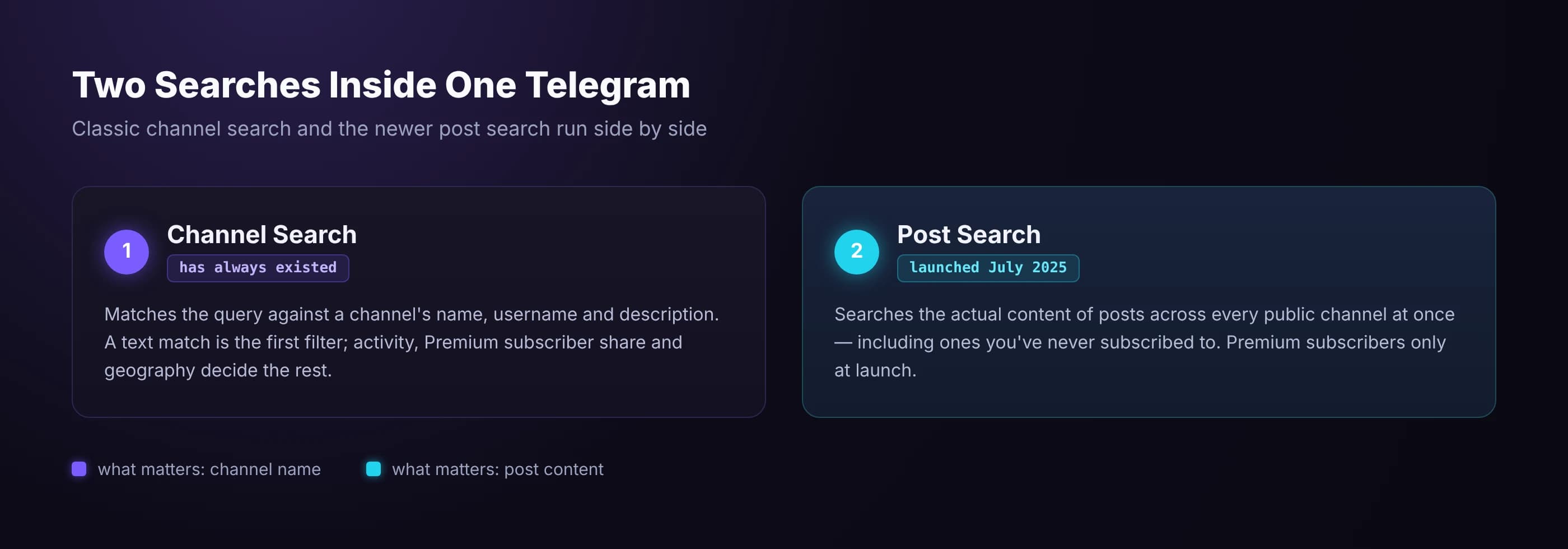
Two searches, not one
The classic search — the one that's always existed — matches channels, groups, bots and users by name and username. Type a word into the search bar, switch to the Channels tab, and public channels whose name or description contains that word show up.
The second search is younger. Since late July 2025, Telegram has had a separate Posts tab that searches the actual content of public posts across every public channel at once, including ones a person has never subscribed to. Telegram described it as a way to find the original source of information and compare channels side by side in one interface. At launch, the feature was available to Premium subscribers only.
The difference matters. One search cares what your channel is called. The other cares what you actually write in it. A channel can run for years under a forgettable, random username and still surface reliably in post search, while a perfectly chosen handle does nothing if nobody is publishing anything worth finding.

September 2023: when Telegram stopped counting bare follower numbers
Before September 2023, channel rankings leaned heavily on one number: subscriber count. The logic was simple — more people in a channel, the higher it climbs for a given search term. Spammers figured that out fast and started inflating follower counts with bots to outrank honest channels.
Durov announced the fix directly in his own channel: from that point on, ranking would count only "genuine" subscribers, weighted heavily toward people with a Premium subscription. Channels with a higher share of Premium subscribers would generally rank higher. To stop that from being gamed just as quickly, Telegram capped how much a single Premium account could contribute — a subscriber who had joined too many channels wouldn't give any of them much of a boost. The same update made search lean harder on geography: results started differing noticeably depending on which country a search was coming from.
The same batch of changes introduced the Boost system for channel stories and tied it to Premium the same way: only Premium subscribers can hand out boosts, so a channel padded with fake followers has nowhere real to get them from.
What people who run channels tend to point to
Official clarifications have been scarce since then, but the people actually running channels have built up a fairly consistent list of observations. None of it is confirmed by Telegram directly, but the same patterns keep showing up across enough different channels to be worth taking seriously.
A match between the search term and the channel's username or name is still the first filter — nothing else gets considered until that's satisfied. Private channels never appear in search results at all, no matter how engaged their audience is. Channels that post regularly tend to beat ones that have gone quiet; Telegram clearly isn't interested in sending people to a dead storefront. Among channels of similar size, the ratio of views to subscribers often decides it — a more honest signal of whether people are actually reading than a subscriber count that just looks good on paper. Channel age plays a role too: a new channel has to outrun its competitors while also working against the algorithm's own caution toward anything unproven.
Moderation is its own story. In September 2024, Durov said Telegram's moderators and AI tools had gotten more aggressive about identifying channels and bots selling illegal goods through search and pulling them from the results, and invited users to flag similar content through the SearchReport bot. A complaint against a channel works as a ranking signal too, just pointed the opposite way from views.
Worth naming directly: some of the services selling inflated Premium subscribers or bots "to climb in search" are exactly the audience the 2023 update was built to push down. A guaranteed top spot for a price is a claim worth treating with suspicion — that is precisely the kind of scheme the algorithm is designed to spot and discount first.
The other search results: Google
Public channels also have a web version — pages at t.me/s/channelname that open in an ordinary browser, no app required. Search engines index these pages like any other website, and over the past couple of years Google has gotten noticeably more active about picking them up: individual posts earn their own snippets and surface for the same queries as regular articles.
This runs on ordinary web search rules: what matters is keyword placement near the top of a post, external links pointing to that specific post, and behavioral signals in the search results — Telegram's own internal search mechanics have no part in it. That's why a channel can rank well in Google for a topic and barely show up for the same topic in Telegram's own search, or the other way around. Checking whether a channel's posts are indexed is as simple as a site search, and for a channel or site with dozens of posts it's worth checking indexing in bulk rather than paging through results by hand.
What to actually do
None of this adds up to a formula. But a rough order of priorities does fall out of it.
Start with the name and username: the keyword close to the front, nothing like "official," "top," or a year tacked on the end — none of that adds relevance, it just takes up space. Next comes status: the channel has to be public, or none of the rest matters from a search standpoint. After that, posting rhythm — daily isn't required, but going quiet for weeks clearly costs you; the algorithm rewards a channel that's visibly alive. Worth watching in parallel: how many subscribers actually open and read through posts. That's where the funnel inside the channel itself ends up mattering more than any name — or any subscriber count — ever will. Bought bots damage that number faster than a good username ever helps it. Geography can't be ignored either: results for someone in one country and someone in another can differ enough to matter, so it's worth checking rankings from more than one account. And complaints against a channel hurt visibility faster than any other single factor, which makes any borderline growth scheme not worth the risk.
Since Telegram publishes nothing and changes the rules without warning, the only approach that holds up is building for what real people actually search for and read. A set of signals will need just as much rework after the next update as it did after this one.
