
This is what a live commerce session looks like in China: the host turns a jar of face cream toward the camera, sniffs it, dabs it on the back of her hand, and glances at the chat, where the comment counter is climbing faster than she can read it. Thirty seconds later a price appears on screen — a third lower than the regular listing, good only for whoever taps the button in the next five minutes. A batch of several thousand units sells out before this paragraph is done.
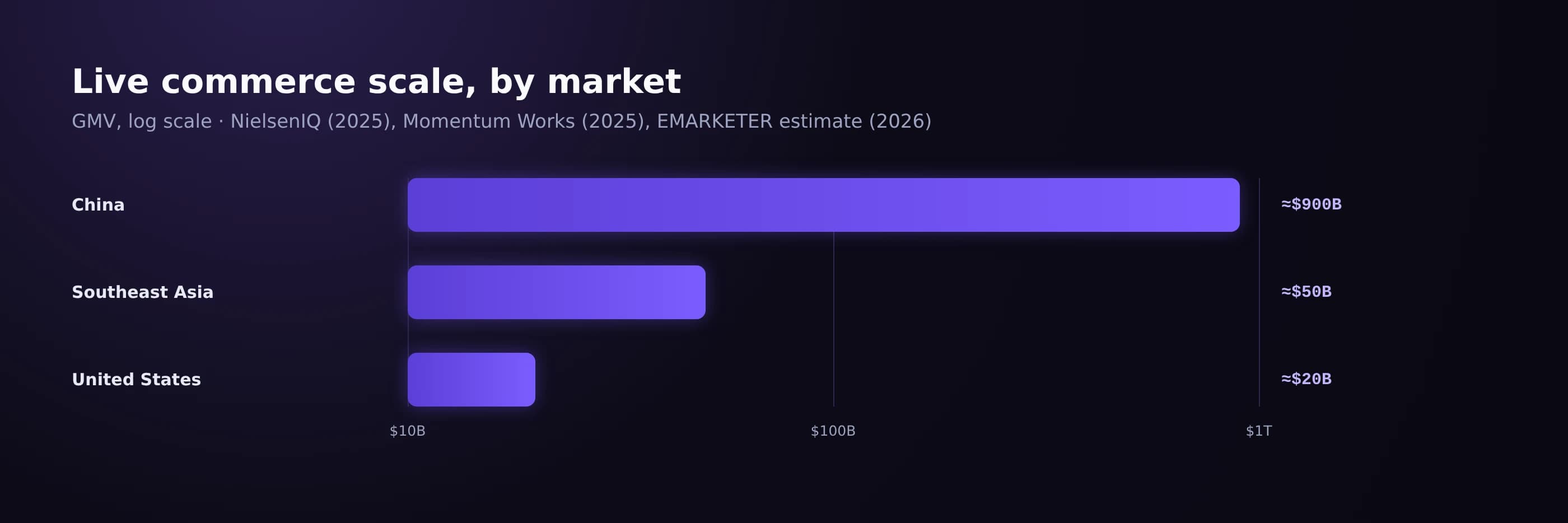
In China, that's not a stunt or a viral clip. It's an ordinary part of retail. The format started in 2016, when the marketplace Taobao first built a buy button directly into video broadcasts, and it has since grown into something a 2026 NielsenIQ report compares, in annual turnover, to the entire e-commerce market of the United States. Livestreams now account for roughly 60% of all online retail in China, against about 5% in the US, according to ARK Invest. As of the end of 2024, three-quarters of the country's internet users — more than eight hundred million people — watched these broadcasts, and for plenty of them a shopping stream had quietly replaced the evening soap opera. The same mechanic is now being tried in Jakarta, London, and New York, with very mixed results.
One stream, thousands of orders
A good selling stream isn't shot like a vlog — it's staged like a performance with a script. The host (the trade term is "anchor") doesn't just describe a product; she compares it with competitors, pressures the brand on camera into an extra discount, then presents that discount to viewers as a personal win on their behalf. Then comes the countdown, a cap on units, and a line about how this price won't come back soon. It's the same scarcity-and-urgency playbook used in impulse buying everywhere — just run live, to a million-strong audience, with no ad breaks.
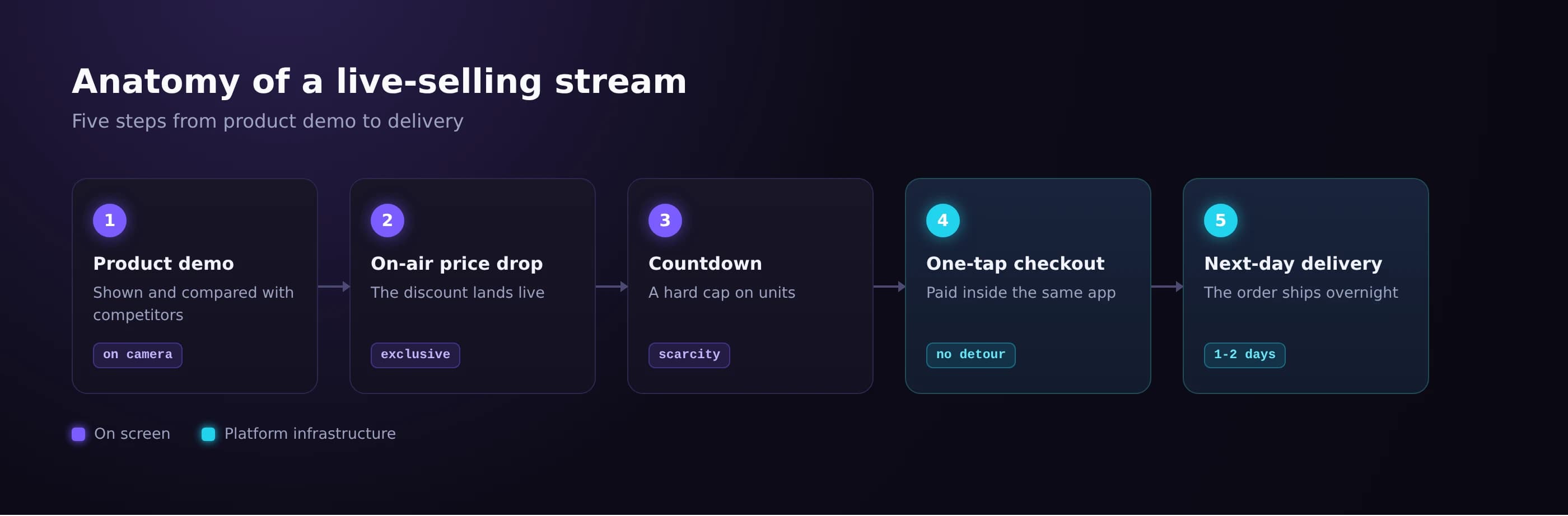
The buy button sits inside the same app as the broadcast, so there's no detour to another site, no re-entering a card number, no new app to install between "I want it" and "paid" — one tap closes the order. That sounds like a small thing, but it's the reason conversion on Chinese livestreams runs several times higher than on an ordinary product page in a Western store: a Western shopper gets distracted hunting for a wallet, while a Chinese one just keeps watching with the item already in the cart. The same principle — stripping out the one extra step between deciding and paying — shows up in cash-on-delivery checkout design: different mechanic, same logic: fewer barriers at checkout, higher conversion.

The infrastructure viewers never think about
Behind a single broadcast sits an industry roughly the size of a film production. Big brands run dedicated studios running several streams at once across platforms — Douyin (TikTok's sister app in China), Taobao Live, and Kuaishou split most of the GMV between them, with Douyin, according to an industry brief for US exporters, already ahead of its rivals on total turnover. Hosts are booked through agencies China calls MCNs, a profession with its own casting pipelines, hierarchy, and ranking systems. The format has long outgrown polished studios, too: in rural areas and at factories, small sellers broadcast straight from a warehouse or a field, pitching a harvest or a finished batch the way a market crier once would — just on camera now.
The other half of the equation is logistics. An order placed during a ten p.m. broadcast in a major Chinese city often shows up the next morning, because the payment system lives in the same app as the warehouse, the courier, and customer support. That's the "super-app" effect analysts point to when explaining why the format took off here first: one window to watch, decide, pay, and get a tracking number, without ever leaving the app. For the seller, it's also a direct channel with no middleman beyond the platform's own cut.
The Lipstick King and his AI twin
China's best-known seller is Li Jiaqi, whom the press dubbed the Lipstick King after he moved 15,000 lipsticks in five minutes of airtime. In early November 2026, mid-way through the Double 11 shopping festival, he ran a stream selling not cosmetics but digital tokens from an AI platform — two trillion units changed hands in thirty minutes. To him, it's a sign of how fast the product mix on this channel can turn over: lipstick yesterday, tokens today, and the audience reacts the same either way.
But in 2026 the channel's human stars picked up a rival that never gets tired and never sleeps. Digital avatars — AI hosts — can run a broadcast around the clock, repeating the same sales lines with the right inflection every time. JD.com made its AI hosting service free to merchants in late 2025, and by the company's own account, adoption surged within three months: an AI host costs 80 to 90% less than a human one. For small sellers, that means a near-permanent presence on air instead of just the hours when someone can actually sit in front of a camera — a similar shift toward automating repetitive selling tasks is already playing out in affiliate marketing.
Regulators moved fast. Since February 2026, rules require AI hosts to be labeled and viewers to be told plainly they're watching a digital stand-in, not a person. Douyin went further and banned broadcasts run entirely by an avatar with no human present at all. Li Jiaqi himself, speaking to reporters in the fall of 2026, was careful about where he'd draw the line: AI, he said, is useful as an assistant that can keep a stream running overnight while he rests, but not as a full replacement — because a model is always thinking with yesterday's version of him, never today's.
Why the West didn't catch on the first time
Facebook tried its own Shopping Fridays. TikTok launched Live Shop across Europe and the US. Amazon has run a dedicated Amazon Live section since 2019. All three were eventually frozen or scaled back over weak viewer engagement — the Financial Times reported that TikTok paused the expansion of its live shopping product in Europe for exactly that reason.
The real obstacle isn't technology; it's habit and infrastructure. A McKinsey survey, still cited as the reference point for that gap, found back in 2023 that 87% of frequent live-commerce users in China tuned into shopping streams at least once a month, against 43% in the US and 52% in Europe. Roughly 57% of Chinese users had stuck with the format for more than three years, while in the US and Europe most users had only tried it for the first time in the year before that survey. Western shoppers aren't used to paying inside a social app — they expect checkout on a separate site with a card entered separately, and every extra step in that chain costs some share of the audience. Add logistics: a Chinese buyer waits a day or two for delivery, a Western one usually waits several days, and the "I just bought this, right now" feeling collapses while the package is still in transit. There's a more down-to-earth reason too: Western brands are used to owning their own storefront and customer data, and a format where a third-party host's charisma does the selling, on someone else's platform, cuts against that instinct — which is part of why big retailers stay cautious even when the audience is theoretically ready to watch.
The format is still spreading — just not by copying
While the classic Chinese playbook struggled to take hold, a looser version grew up alongside it. TikTok Shop in the US more than doubled its live-shopping sales in the first half of 2026 compared with a year earlier, with hours streamed growing even faster — against a backdrop where total US live shopping, per EMARKETER, still sits around $20 billion a year, versus hundreds of billions in China. The telling detail: on TikTok Shop in the US, live broadcasts still aren't the main sales channel — short video drives most of the volume, and affiliate creators working for commission matter far more there than they do in China. Anyone eyeing that model as income should first understand how affiliate earnings on TikTok actually work before ever stepping in front of a camera.
Southeast Asia took a third route. In Indonesia, by local estimates, around 60% of shoppers buy through livestreams, and the region's live and video commerce turnover nearly doubled in 2025. Vietnam grew roughly 150% that same year — fast enough that local regulators rolled out dedicated e-commerce rules that took effect in mid-2026. The format mix there landed more balanced than in the US, though still without the all-in-one payment-and-logistics stack that China itself runs on.
The most unexpected export of the format is AliExpress's London livestream during Double 11 2026: the main sale in China opened on October 17 and runs through November 13, and in that same window AliExpress ran a broadcast for UK viewers built around Pop Mart collectible figures, using the same scarcity and limited-batch mechanics that work in Shanghai. For sellers already running a dropshipping business who are eyeing live selling as a next channel, that's a signal more than a ready-made playbook: Chinese platforms are still testing, on viewers in London, which parts of the format survive the transplant onto someone else's infrastructure — and which have to be rebuilt from scratch.
