
Scroll through almost any brand's feed — sneakers, a bank, a deodorant, an airline — and you'll quickly hit the same construction. "We're not just sneakers." "More than a bank." "It's not just coffee, it's something more." The "more than" formula stopped being one copywriter's clever line a long time ago and turned into a reflex: hardly any brand dares to describe itself plainly anymore, without bolting on some meaning, mission, or lifestyle. It's worth asking where the phrase came from, why it actually worked for a while, and why today it mostly reads as noise.
Where the formula comes from
The construction's roots sit in positioning theory rather than in ad copy. In 1981, Al Ries and Jack Trout published "Positioning: The Battle for Your Mind," which reframed the whole industry around one idea: positioning doesn't happen to a product, it happens inside a buyer's head. A brand can't change what's in the can, but it can change the place that can occupies among the thousands of other thoughts and associations already crowding a person's mind. That's the root of describing a product not by what it does, but by the spot it's meant to fill in someone's life.
A year later, in 1982, marketing researcher Jonathan Gutman proposed a theory that explained the mechanism at the level of decision psychology — the means-end chain. The short version: people don't choose a product for its attributes alone, they choose it because those attributes lead to a functional benefit, which leads to an emotional consequence, which in turn reinforces some personal value. A lighter bike rides faster, a faster ride saves time, saved time feels like control over your own life. The interview method that pulls that whole chain out of a shopper, question by question, became known as "laddering" — and it quietly supplied the theoretical scaffolding behind "it's not just X."
Practice got there before the theory did, though. In the late 1960s, Coca-Cola built a campaign around "It's the Real Thing," selling authenticity rather than taste or formula, at a moment when Americans were genuinely hungry for something that felt real. In 1983, Howard Schultz traveled to Italy and noticed that local espresso bars worked less like coffee shops and more like neighborhood social hubs; the trip is what led him to build Starbucks around the idea of a "third place" between home and work, where coffee was the excuse rather than the product. Both cases share the same trait: the brand found a genuine cultural nerve and built a business around it, rather than inventing a pretty line for the label.
The turning point for the industry came in 2004, when Dove launched its Real Beauty campaign. The trigger was a study the brand had commissioned itself, which found that only 2% of women worldwide would call themselves beautiful. Dove stopped selling soap as soap and started talking about self-esteem, backing the words with action: the Dove Self-Esteem Project, ads cast with ordinary women instead of models, a product range widened to cover more skin tones. It worked not because the line was pretty, but because real decisions sat behind it. Five years later, in 2009, entrepreneur and author Simon Sinek used one of the earliest TEDx talks to lay out his "golden circle": people don't buy what you do, they buy why you do it. The talk spread through business schools and marketing departments so widely that it turned one brand's private trick into an entire industry's default setting — meaning first, product second.

How the phrase works inside a buyer's head
Looked at through Gutman's ladder, the "more than" phrase is literally a shortcut up it. Ordinary advertising has to climb every rung: show the attribute, explain the benefit it produces, then hint at the emotion and value behind it. "It's not just X, it's Y" skips the middle rungs entirely and wires the product category straight into the buyer's identity. The brain takes that jump cut surprisingly well — partly because Sinek's golden circle had already trained audiences to expect "why" before "what," and partly because the "not just A, but B" syntax matches how people naturally phrase an insight: first overturn an expectation, then reveal the deeper truth.
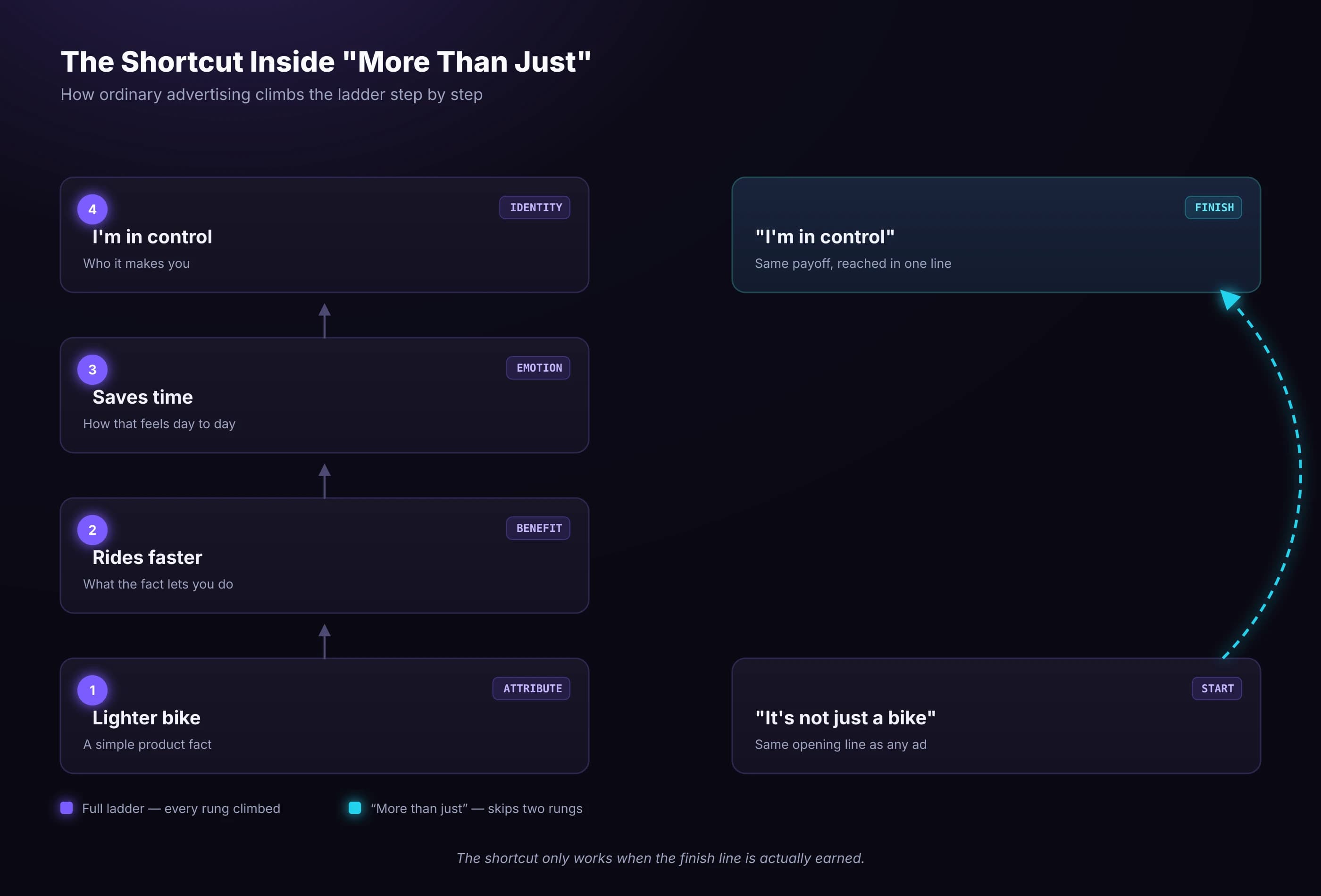
The catch is that the shortcut only holds up when B is actually true. If the line simply rearranges words with no decision behind it, a buyer notices the emptiness fast — the gap between the promised identity and the real experience shows up by the second touchpoint.
Who plays this game, and where
In sports, the sharpest example is the story behind "More Than An Athlete." In February 2018, Fox News host Laura Ingraham told LeBron James to "shut up and dribble" after he spoke out on politics. James answered with an Instagram post of a neon sign reading "I am more than an athlete," and his media company, Uninterrupted, quickly turned the line into its core slogan — apparel through a Nike deal, a show on ESPN, an integration into the NBA 2K video game. It turned out the phrase was worth real money: in 2020, a Maryland nonprofit, Game Plan Inc., filed a $33 million lawsuit claiming it had used and registered a similar phrase earlier. The dispute ran for nearly four years before the U.S. Trademark Trial and Appeal Board confirmed James's and Uninterrupted IP LLC's rights to the slogan in December 2023. It's hard to find a clearer proof that "more than an athlete" stopped being a figure of speech and became an asset worth fighting over in court.
In fintech, the line is so well-worn it has turned into a stock part off the slogan-generator shelf. The banking app Capway describes itself as "More than banking. The opportunity," and BankPlus states outright: "It's more than a name. It's a promise." Round-ups of generic bank taglines include the literal line "More than just a bank" as one of the most predictable options available — predictable enough to drop into any payments app, with the logo being the only thing that changes.
In beauty, Dove remains a rare case of the formula surviving two decades precisely because it was backed by action rather than wording alone: a wider shade range in its advertising, an education program that has reached millions of girls worldwide, and a consistent message campaign after campaign.
In food and beverage, the same principle shows up at Starbucks: the "third place" idea started with a decision, not a slogan — soft chairs, no time limit on how long you could sit, baristas trained to remember names. The line came after the café experience itself had already changed, not instead of it.
In technology and fashion, the construction usually drops the literal "more than" but works the same way underneath. Apple's 1997 "Think Different" campaign deliberately echoed IBM's corporate slogan "Think," only inverted — Apple wasn't selling computing power, it was selling the identity of someone who thinks differently. Nike has described itself as a lifestyle brand rather than a sneaker maker for decades, which is exactly why its collaborations with musicians and designers work for the company just as hard as its athletic results do.
When the trick turns into a cliché
The formula started to grate the moment it stopped being rare. While only a handful of brands with genuine cultural footing used "more than" — Dove, Starbucks, later Nike with James — the line worked as a signal: here's a company willing to back its words with action. Once the trick proved it worked, categories with no study, no program, and no rebuilt product behind them started copying it anyway, chasing nothing but the sound of being current. The result is that the same syntax now covers both a bank that genuinely rethought its relationship with customers and a bank that just redesigned its homepage and dropped a trendy phrase into the header.
The line between the formula working and the formula being a cliché isn't about how pretty the sentence sounds — it's about whether you can finish it with one concrete sentence naming what the brand actually did differently. Dove can finish that sentence: widened its shade range, recast its advertising, launched an education program. Thousands of nameless "more than just a bank" lines usually can't finish it at all, which means the phrase is running on syntax alone, with nothing behind it.
What happens to trust once the cliché gets spotted
Audiences learn fast to tell a claim from proof. When the formula was still new, the gap between promise and reality was harder to notice — people simply hadn't seen enough examples to compare against. Today, after two decades of the trick appearing in every category at once, any new "we're not just a product" gets checked against dozens of earlier versions of the exact same line almost instantly, and if nothing turns up behind it beyond tidy syntax, trust drops faster than it ever built up.
LeBron James's case is the exception that proves the rule: the phrase became valuable enough to litigate over for years, but what gave it that value wasn't the turn of phrase itself — it was the real media platform, the real Nike deal, the real cultural moment standing behind it. Most brands dropping "more than" into their homepage copy have none of that support, which is exactly why the line costs them nothing to use and earns them nothing in return — not from the business, and not from a buyer who long ago learned to scroll straight past it.
