
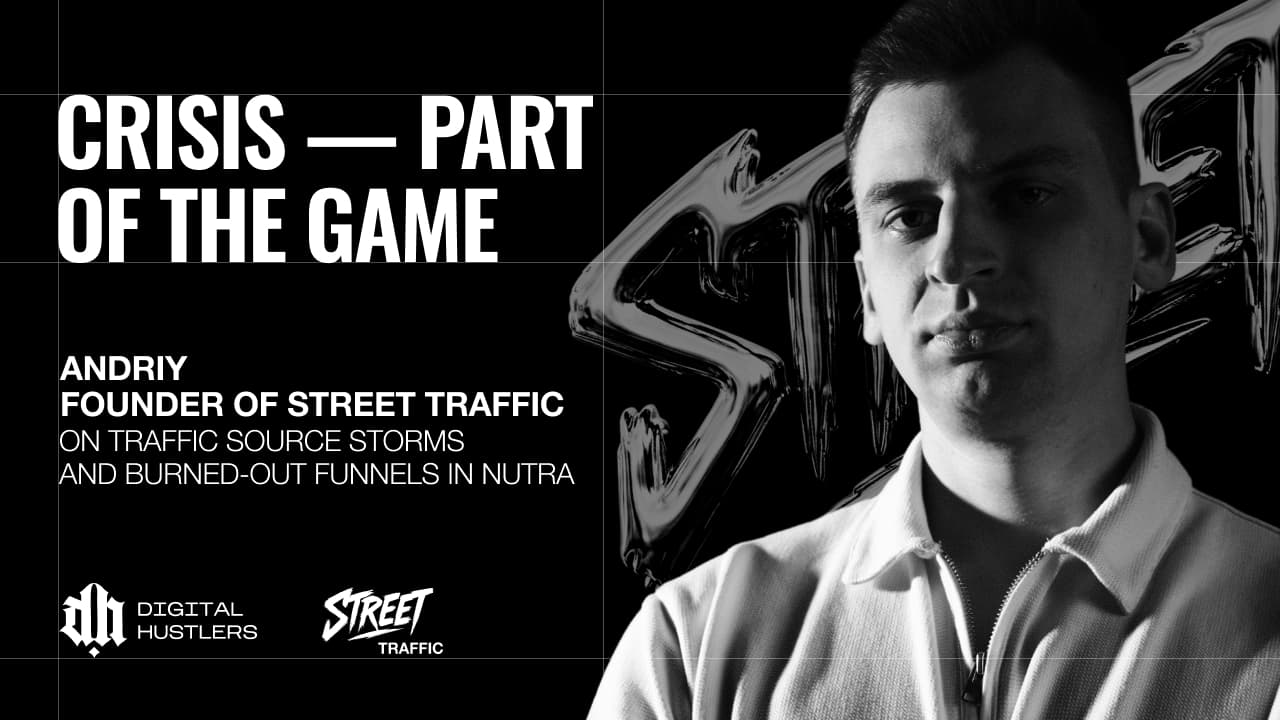
The biggest illusion beginners have is expecting easy money. In practice, the only things that come easy are frayed nerves and red numbers in the tracker.
When you run a team, “waiting it out” simply isn’t an option. Every day of downtime burns operating costs just as efficiently as a failed campaign does. So during a drawdown, you’re really just choosing where to lose: stop, and you’re guaranteed a cash gap on salaries and software; keep spending deliberately, and you might find a new conversion angle or a way around the traffic source’s restrictions.
Anatomy of an Affiliate Crisis: Two Problems That Burn Your Budget
In nutra, there are two main crises that hit your wallet hard: your working funnels burning out, and the traffic source itself going into a storm.
1. If a funnel has burned out, you need cold calculation and a dedicated discovery budget.
You have to set aside a testing budget upfront, one you’re prepared to lose entirely. Without a controlled loss, you’ll never get back into profit. A typical mistake some teams make during a drawdown is turning cautious: allocating pocket-change budgets, stretching tiny spends over weeks, and waiting for a miracle. In the end, they just lose precious time while the team sits without traffic.
We do it differently: we launch fast and systematically. That doesn’t mean mindlessly pouring budget down the drain. We break the test into a clear split of specific hypotheses: different creative approaches, new pre-landers, other angles, or other GEOs. Yes, a broad hypothesis test can burn a noticeable amount in the moment and put you temporarily in the red. But within a day or two, we have objective numbers: we can see where conversion picked up and what can be confidently scaled, and where we need to cut costs immediately.
2. If the source itself is choking you, it’s time to cycle through setups.
This is when traffic breaks at the root: mass account checks, micro-spends, endless creative rejections, payment methods dropping off, and accounts banned before they even clear moderation. Running campaigns the way you did yesterday no longer works. Most people’s first reaction is to pause everything and “wait for it to blow over.”
But pausing is self-deception and the most expensive mistake you can make. Fixed infrastructure and team costs keep ticking every single day. If you’re standing still, you’re already locking in a direct loss.
In periods like this, you don’t need pauses. You need focused resources aimed at finding solutions: testing other types of setups, rebuilding your tech stack and account management, or finding a new approach to passing moderation. Both crisis scenarios are equally dangerous, so we go through them together, quickly, and without illusions. Sitting around hoping for a miracle is a slow death for a team.

The Firefighting Algorithm: From Small to Large
When a crisis hits, everything usually breaks at once: accounts get banned, payment methods drop off, the farm can’t keep up with setups, and the approval rate at the affiliate network sinks. Trying to put out every fire simultaneously is guaranteed chaos and a pointless drain on resources.
What matters most is a strict order of operations. I approach it purely structurally and move strictly from small to large:
First focus: put out the fire where the business is losing the most money and strategic opportunities.
Second focus: eliminate process downtime where something has failed but fewer people are involved and current financial losses are lower.
We work through problems one at a time and don’t let chaos scatter the team’s attention and resources.
The Risk of Scaling and the Danger of Templates
Early on, I had a harsh experience: we started scaling a profitable vertical very fast, and at one point everything came crashing down. Carrying high costs when every storm pushes you to the edge of bankruptcy is just too painful. Rapid growth is often followed by a rapid fall. After that, I didn’t fire anyone, but we deliberately slowed down: first we closed every weak point in our infrastructure, and only then started growing steadily. I’ve become much more cautious in that respect.
Another dangerous trap during growth is total templating. We had a period when every media buyer worked from the same playbook: identical account setups, the same technical solutions, cookie-cutter funnels, and even the same approach to creatives. In affiliate marketing, an assembly line doesn’t last long, for two reasons.
First, as soon as the source’s algorithm spots a shared technical pattern, the entire team goes down in a single day.
Second, identical funnels burn out the auction instantly: offers get squeezed many times faster, creatives cause audience fatigue, and conversion rates crash.
That’s exactly why at Street Traffic we now teach every media buyer to think for themselves. We don’t build an assembly line of button-pushers. We provide a rock-solid foundation, but from there each specialist has to fine-tune setups, test their own approaches, and find their own funnels. That’s the only way unique campaign models emerge in-house: when a storm hits the source and knocks out one buyer’s approach, the others keep running profitably.
Why a Business Shouldn’t Depend on Top Buyers, and How to Eliminate Systemic Mistakes
In my experience, there have been times when strong specialists delivered great numbers in the short term but then got a big head and started destabilizing the team from within.
A common trap is being afraid to part ways with people like that, fearing that revenue will collapse along with them. But someone playing their own games inside the team hurts the business far more than any market storm.
When we made the tough call and parted ways, the system didn’t just hold up, it showed its real strength. The atmosphere settled, and in a healthy working environment the team started posting its own record results. No performer, however profitable, is worth splitting the team. A business should rest on a resilient system and mutual respect, not on the ambitions of individual “stars.”
How to Turn Lost Budgets into Experience
When a funnel isn’t working during a storm or drawdown, a media buyer shouldn’t be left alone with a red tracker, burning budget chaotically. That’s the team lead’s job: step in, adjust the hypotheses, and point the buyer in the right direction. The team lead holds the big picture, sees the failed tests, and keeps the team from going down dead ends. The budget spent on those tests is a normal cost of discovery: in affiliate marketing, you either take the profit right away or get hard data to analyze, which leads to profit.
But sometimes the funnel isn’t the issue at all. Payment methods drop off, the farm can’t deliver decent setups, the tech starts glitching, and as a result buyers simply can’t run traffic consistently.
If a failure becomes systemic, you can’t turn a blind eye. It means a specific process has broken down somewhere. The question is simple: either someone isn’t handling their part, or the person was poorly briefed on how it should work in the first place. These things need to be found and fixed immediately, not left to burn for weeks.
Three Tips for a Small-Team Founder Who’s Hit a Dead End
If a lead or founder of a small affiliate team came to me today, caught in a severe storm and unsure what to grab onto first, I’d point to three basic steps.
Get into the ad accounts yourself. Launch setups with your own hands and feel how the source behaves right now. Managing a storm purely from reports leaves you blind. You need to see firsthand exactly where the setup breaks and where the buyer stumbles.
Structure your tests. Stop the chaotic moves and set emotions aside. Break your recovery into a sequential queue of hypotheses, from basic technical fixes to tests of new creative approaches.
Share findings fast. Anything that gains traction or solves a technical problem should instantly become a shared team resource. Today one buyer finds a way past the checks; tomorrow another lands a converting angle. A team’s strength lies precisely in scaling every solution to everyone without delay.
I’ve always valued buyers who can solve problems at their own level and find a way out instead of waiting for ready-made instructions. Those are the specialists who grow into strong team leads over time and form a core team that no storm can break.
What Crises in Affiliate Marketing Really Teach You
A crisis in affiliate marketing isn’t an anomaly; it’s the normal working environment for any growing team. Sources will keep tightening the screws, algorithms will keep changing, and setups will keep getting banned. The strategy of “sitting out the storm until things get back to normal” never works here. You just burn time and resources.
The difference between those who survive and those who shut down comes down to one thing: some look for someone to blame and hope the old days return, while others methodically work through hypotheses and rebuild their approaches.
Crises reveal how strong your system really is: how well departments work together, whether people can make decisions on their own, and whether they can test new hypotheses quickly. When these processes are in place, no storm is a catastrophe anymore. It becomes just another working task that makes the team stronger.
STREET TRAFFIC on social media:
➤ Telegram: https://t.me/streettrafficagency
➤ Instagram: https://www.instagram.com/streettraffic_agency?stkn=MTJlZGtoeDc4cTVnYg==
➤ All team contacts: https://linktr.ee/street_traffic?utm_source=linktree_profile_share<sid=07797bd2-d85f-470a-a617-c7e40e9a6a44
