
Brazil's iGaming market is undergoing one of the most significant transformations in recent years. The Brazilian president's decision to ban fixed-odds betting operations has dramatically reshaped the country's competitive landscape. The restrictions have affected two key segments of the industry: sports betting and online casinos.
The scale of these changes becomes particularly clear when comparing brand rankings for September and October 2026. In September, licensed operators such as Betano, Bet365, and Superbet held the leading positions. Just one month later, however, the entire ranking was made up of offshore brands.
The biggest beneficiary of these changes was 1win, which claimed first place with a score of 31.81%. It was followed by Bingo Em Casa, Stake, Brabet and Melbet.
The Brazilian authorities' decision has therefore done more than simply change the conditions under which operators can operate. It has triggered a major shift in the competitive landscape. At the same time, it raises a broader question: how effective is a complete withdrawal from a regulated market if consumer demand for gambling remains?
Let's take a closer look at what happened to one of the world's largest iGaming markets, which operators have emerged as the main beneficiaries of these changes, and why the chosen approach could end up benefiting the very companies that are harder for the government to control.
How Lula Moved to Shut Down Brazil's Legal iGaming Market
On September 25, 2026, Brazilian President Luiz Inácio Lula da Silva signed Provisional Measure MP 1.394, which introduced a ban on operating, offering, brokering, and advertising fixed-odds betting services within the country.
The measure covers bets on real sporting events, as well as virtual events in online games whose outcomes are determined by a random number generator. As a result, both sports betting and online casinos fall under the restrictions.
The ban applies not only to domestic operators but also to foreign companies offering these services to users located in Brazil.
Following the measure's publication, operators were given 30 days before their federal and state-level licenses were terminated. Betting websites and apps were required to cease operations by October 6, while all authorizations expired on October 25.
In effect, the authorities brought the licensing system to a halt. Launched in January 2025, it was intended to establish government oversight of the market, protect users, and ensure transparency in operators' activities.
It is important to note that the measure does not ban every form of gambling in Brazil. Other types of lotteries permitted under Brazilian law are not covered by MP 1.394.

From Betano to 1win: How the iGaming Brand Rankings Have Changed
The impact of the Brazilian authorities' decision is most clearly illustrated by comparing the rankings for September and October 2026.
In September, Betano led the market with a score of 33.26%. It was followed by Bet365 at 10.03%, Superbet at 8.11%, and Sportingbet at 5.92%. The ranking was dominated by operators that were part of Brazil's licensing system.
By October, however, the picture had changed almost completely.
1win took the lead with a score of 31.81%. Bingo Em Casa ranked second at 11.36%, followed by Stake in third place at 9.89%. Brabet, at 9.7%, and Melbet, at 5.57%, also made it into the top five.
Every brand featured in the September ranking had disappeared from the October list. They were replaced by operators that had not been part of Brazil's previous licensing system.
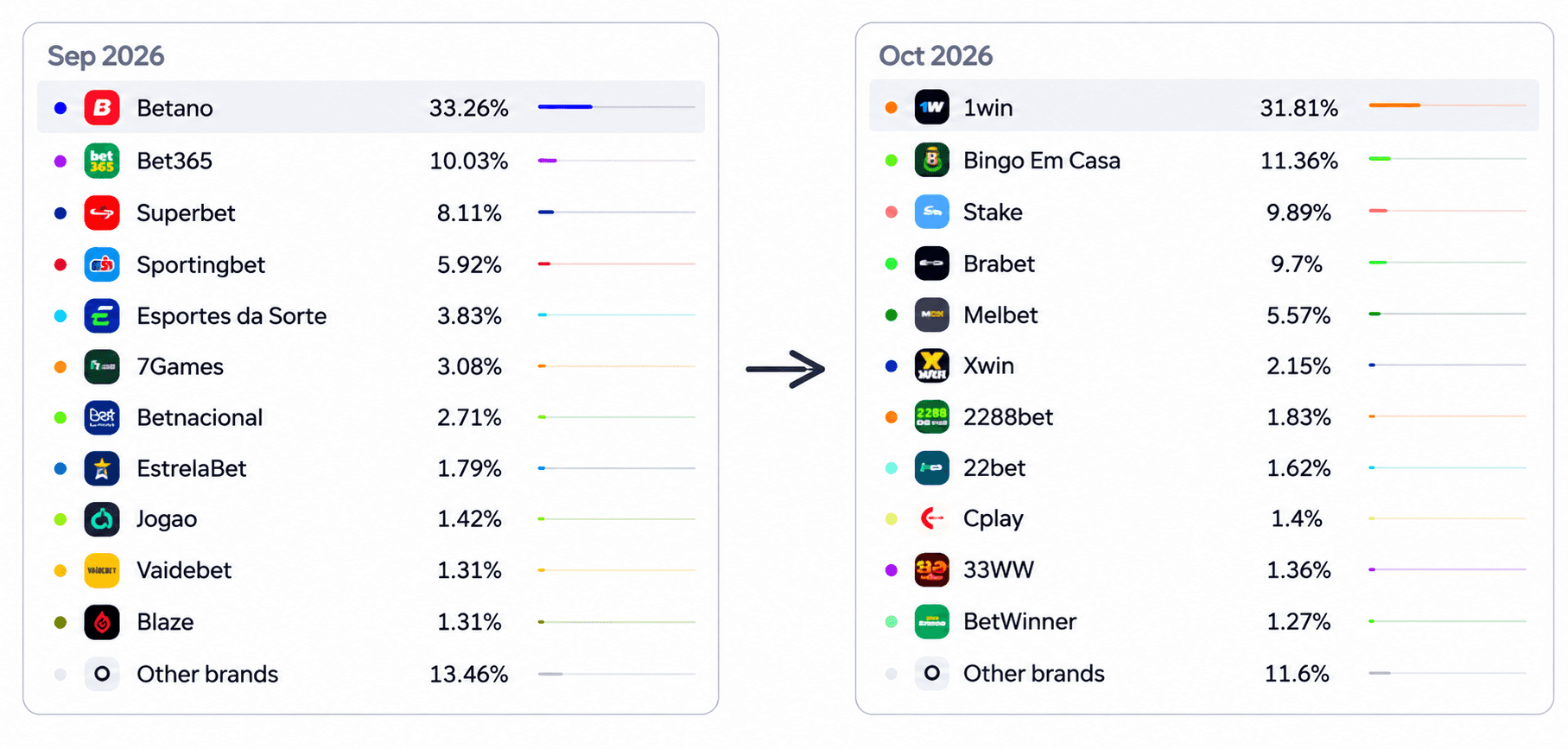
1win's performance deserves particular attention. The brand did not simply top the October ranking; its score was also comparable to that of the market's former leader just one month earlier.
At the same time, it is important to note that the percentages shown in the infographic reflect figures from a specific brand ranking. Without confirmation of the methodology, they should not be interpreted as operators' shares of Brazil's total betting turnover or gross gaming revenue (GGR).
Why Offshore Brands Gained an Advantage
At first glance, the situation may seem paradoxical. The government introduces restrictions in an attempt to limit access to gambling and tighten its control over the industry, yet the brands gaining the most visibility are operators based outside the country's licensing system.
The reason lies in the nature of the market itself.
Banning licensed companies from operating does not automatically eliminate consumer demand. People who previously used Betano, Bet365, or Superbet do not suddenly lose interest in sports betting and online casinos simply because their familiar platforms have been blocked.
Some users may give up gambling altogether, others may switch to different forms of entertainment, while some may start looking for alternative platforms. It is this last group that creates opportunities for offshore operators.
International brands already have the infrastructure to operate across multiple markets, established international marketing channels, and audiences beyond Brazil. Some operators also use alternative domains and mirror sites, making them more difficult to block.
Notably, according to analytics platform Blask, the share of offshore brands in measurable branded demand in the Brazilian market increased from 3.9% to 16.9% after the restrictions were introduced. This figure refers specifically to demand share, not monetary turnover.
This does not mean that offshore operators have received official permission to operate in Brazil. The ban also applies to foreign providers of these services. However, the government's ability to monitor and control locally licensed companies is significantly different from its ability to oversee platforms operating across national borders.
As a result, companies that previously invested in licensing, local teams, marketing, and regulatory compliance have lost the ability to operate, while some of the remaining demand has become accessible to operators outside the former legal framework.
1win, Stake, and Other Beneficiaries of the New Market
The changing positions of individual brands deserve a closer look.
1win emerged as the biggest winner. In addition to taking first place in the October ranking, Blask data also shows a significant increase in interest in the brand following the introduction of the restrictions.
According to the platform, 1win's daily Blask Index increased by 341% when comparing the period after the ban was announced with the preceding period. Bingo Em Casa recorded growth of 235%, while Melbet saw an increase of 349%.
However, a higher percentage growth does not necessarily mean a larger absolute increase. Much depends on each brand's starting point.
It is also important to remember that changes in search activity and brand interest do not necessarily translate into an actual increase in deposits or operator revenue.
Nevertheless, these figures indicate which brands were able to respond most quickly to the changing competitive environment.
“Fighting Windmills”: Why a Complete Ban Could Backfire on the Government
This brings us to the key question surrounding the Brazilian authorities' entire strategy.
If the government's objectives are to protect users, combat gambling addiction, reduce financial risks, and prevent illegal activity, how effective can a complete shutdown of the legal sports betting and online casino market really be?
Gambling does not exist solely because of operators and their licenses. Consumer demand is at the heart of the industry. Banning the legal infrastructure does not necessarily mean that demand will disappear along with it.
This creates a contradiction: the government is seeking to strengthen its control over the industry while simultaneously eliminating legal businesses that were already subject to its oversight.
It is a bit like fighting windmills. Authorities can restrict licensed operators, block their websites, and ban advertising, but making consumer demand disappear is far more difficult. The same applies to international platforms that are capable of meeting that demand.
Of course, this does not mean that licensing automatically solves every problem in the industry. A regulated market still requires effective oversight, advertising restrictions, self-exclusion tools, payment monitoring, and meaningful consumer protection.
However, there is a fundamental difference between reasonable regulation and a complete ban.
Rather than developing a system in which operators comply with regulatory requirements, protect users, and take responsibility for their activities, the authorities risk creating a competitive environment in which companies outside the former national licensing framework gain an advantage.
What Happens to Users After the Ban?
Changes in brand rankings alone do not prove that the entire customer base of licensed operators has moved to offshore platforms. To understand the actual consequences, it is important to look not only at the positions of individual brands but also at overall demand trends.
According to analytics platform Blask, interest in licensed betting brands declined significantly after the ban was announced. However, there was no immediate mass migration of the entire audience to offshore platforms.
In particular, the platform's research showed that during the first week after the restrictions were announced, the reach of licensed websites among users in its panel dropped by 74% compared with the usual level. At the same time, the reach of unlicensed platforms remained roughly at its previous level.
This is an important distinction: the ban did not simply cause the entire former market to move to new operators. Some users may have stopped betting, others are waiting to see how the situation develops, while some are looking for alternatives.
Even so, the shift in the competitive balance remains significant.
What Lies Ahead for Brazil's iGaming Market?
At the time of writing, the future of the Brazilian market remains uncertain.
MP 1.394 is a provisional measure that must be reviewed by the National Congress. On November 11, 2026, its validity was extended by another 60 days. A parliamentary decision on the measure is expected by early March 2027.
In addition, industry representatives are challenging the measure, and its constitutionality is being reviewed by Brazil's Supreme Federal Court. As a result, the market's future direction has yet to be determined.
Several possible scenarios can be identified:
- The ban remains in place. In this case, offshore operators will continue competing for the remaining consumer demand, while the government attempts to restrict their activities.
- A return to the regulated model. Parliament may reject the provisional measure or revise the regulatory approach, potentially paving the way for the legal market to reopen.
- A compromise model. The authorities may allow sports betting to continue while maintaining restrictions on online casinos, or introduce stricter requirements for operators, advertising, payments, and user protection.
The latter option is also being discussed as part of legislative proposals. It would allow the government to retain its oversight mechanisms without ruling out legal operations altogether.
Author's Conclusion: The Ban Does Not Eliminate the Market - It Changes the Rules of Competition
In just one month, Brazil's iGaming market has demonstrated how quickly government decisions can reshape the balance of power within an industry. Offshore brands have taken the leading positions previously held by licensed operators, with 1win claiming first place at 31.81%.
But what matters more than the ranking itself is what lies behind these changes. A ban can restrict the activities of legal operators, but it cannot eliminate consumer demand. When legal infrastructure is pushed out of the market, the space it leaves behind may be filled by businesses that are harder to regulate and control.
This is the main paradox of Brazil's strategy: in trying to restrict the market, the government risks strengthening precisely those players over which it has fewer means of control.
